Open any nursery tour and there is a pendant hanging in the middle of the room, usually a paper globe or a small chandelier. It looks wonderful in daylight. Then the baby arrives, and at 3 a.m. you find yourself doing something the photos never show: reaching for a wall switch that floods the whole room with light while a half-asleep baby waits in your arms.
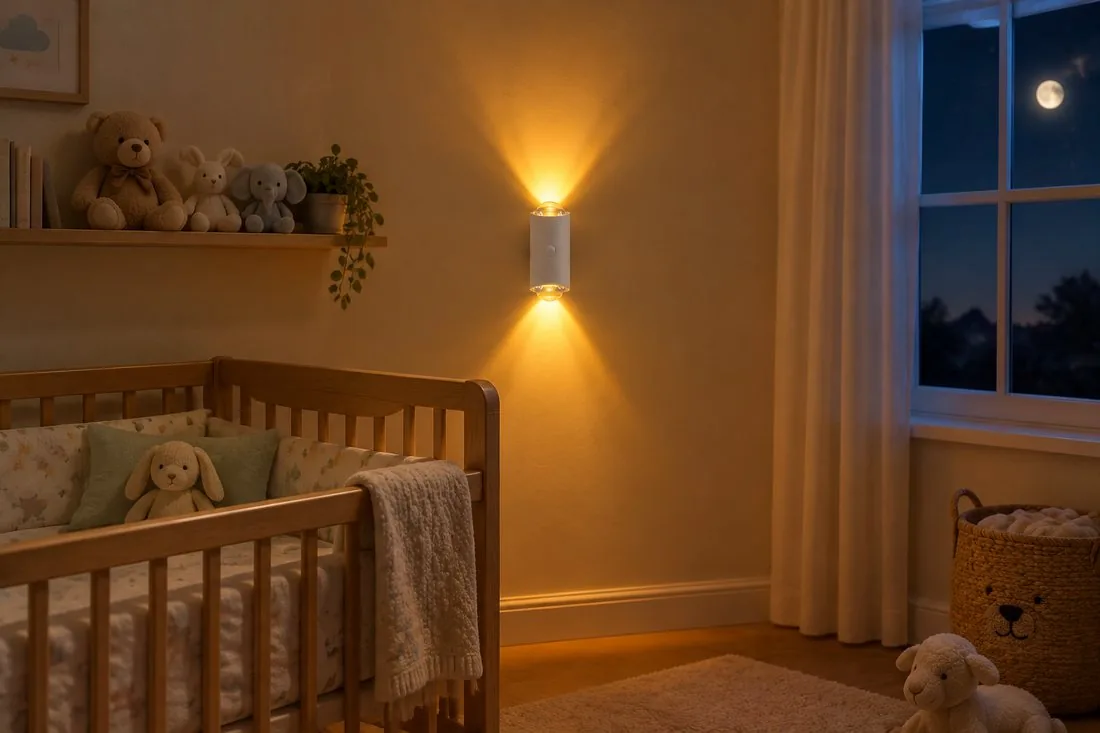
Pendant lights and night lights are not competing products. They do different jobs at different heights, and a nursery works best once you stop asking one fixture to do both.
Two Different Jobs, Two Different Heights
A pendant or chandelier is an ambient fixture: hardwired into a ceiling box, switched at the wall, and designed to light the whole room from above for getting dressed, reading and floor play. A night light is a task light: dim, warm, low, and placed where you actually need to see — the feeding chair, the changing table, the path between them.
The confusion comes from the photographs. A pendant is the only light most nursery photos show, so it reads as "the" nursery light. It is not. It is the light you use at six in the evening.
What a Pendant Really Requires
- An existing ceiling box on a switch leg. If the room only has a switched outlet, or there is no box where you want the fixture, you are looking at an electrician rather than a weekend project.
- A dimmable bulb plus a compatible dimmer. Most pendants ship with a plain bulb on a plain switch, which gives you exactly two brightness levels: full and off.
- Permission to change the ceiling. Renters usually do not have it. Swapping a ceiling fixture is a permanent alteration under most leases.
- Somewhere to stand while you hang it. Hanging height is always a compromise — low enough to look right, high enough that nobody's head connects with it while carrying a baby in the dark.
Why an Overhead Light Fails at 3 A.M.
Three things happen the moment the ceiling light comes on for a night feed. It is bright at the worst possible moment, landing on the baby's face and yours, and bright light at night is the strongest signal that it is time to be awake. It is high and behind you, so your own shadow falls across the exact spot you are trying to see. And it is a switch: to dim it you have to stand up, and to turn it off you have to stand up again.
A small light at hip height next to the chair fixes all three. It stays dim enough to keep the room sleepy, it sits close to the task so nothing is in shadow, and if it is touch-dimmable or motion-activated you never hunt for a switch with a baby in your arms.
Shop This Setup
Two pieces cover the whole plan below: one warm light at the chair, one hands-free light on the path. Both mount or sit with zero drilling.
- At the feeding chair: Baby Night Light with Digital Clock — glare-free warm light, touch dimming and a clock for timing night feeds.
- On the path and at the changing table: No-Drill Motion Sensor Wall Light, White — magnetic mount, PIR up to 16 ft, seven RGB colors, USB-C rechargeable.
- Want two rooms covered? The White 2-Pack Motion Sensor Night Light splits between the nursery door and the hallway.
Four Nursery Lighting Options Compared
| Option | Install | Dimming | Best for | Renter OK |
|---|---|---|---|---|
| Pendant / chandelier | Existing ceiling box; electrician if there is none | Only with a dimmable bulb and dimmer | Daytime ambient light, room styling | No — permanent alteration |
| Plug-in night light | Wall outlet, plus a cord to route | Usually stepped or a small slider | Rooms with a free outlet near the chair | Yes |
| Magnetic rechargeable motion light | Adhesive plate, no drilling, under a minute | Modes plus a single static color | Path, doorway, closet, changing table | Yes |
| Baby night light with clock | Sits on a dresser or shelf, USB charging | Touch dimming | Feeding chair, timing night feeds | Yes |
Cords are the common thread in the middle two rows. Any plug-in option means a cable you have to route somewhere, so keep it short, clip it flat to the wall, and keep it away from the crib entirely.
A Simple Nursery Lighting Plan
- Keep the pendant for daytime. If it is on a dimmer, drop it to the lowest setting for the last twenty minutes before sleep so the room winds down before the lights go out.
- Put a warm, glare-free light at the chair. The baby night light with digital clock gives you touch dimming and a clock for feed timing, and it charges over USB rather than needing an outlet behind the glider.
- Put a hands-free light on the path. The magnetic motion sensor light sticks to the wall on an adhesive plate and switches itself on and off, so you never touch a switch on the way to the changing table.
- Keep both low near the crib. At or below mattress height, and never mounted on the crib rail itself.
- Recharge during the day, not at night. A USB-C light tops up in about three hours, and in AUTO mode the motion light can last up to 120 days between charges.
Safety Notes That Matter More Than Style
- Never run a cord across, over or near the crib.
- Keep pull chains and hanging fixtures out of reach of a standing toddler.
- Do not drape fabric over a bulb or shade — use a cool-running LED.
- Have any new ceiling wiring installed by a qualified electrician.
- The rechargeable lights here are rated IP20, which means indoor use only. Keep them out of damp rooms and away from water.
The Short Version
If the room already has a ceiling box, a dimmable pendant is a nice thing to have for the daytime. It is not the light that gets you through the night. That light is small, warm, low and within arm's reach — and it does not need a single hole in the wall. Prices and availability change on Amazon US, so see the current price on Amazon before ordering.
Warm Light Where You Need It
Magnetic, rechargeable and touch-dimmable lights for the feeding chair and the night path — no drilling, no ceiling work.