A wall sconce is the one fixture renters almost never get. It needs a junction box, a switch and an electrician, and a lease almost never allows any of the three. So the practical question is not which sconce looks best — it is which sconce-shaped light you can actually hang on a rented wall and take down again.
There are three routes, and each fails in a different situation. Knowing the failure mode is what saves you from a damage charge or a sconce that sags off the wall in three weeks.
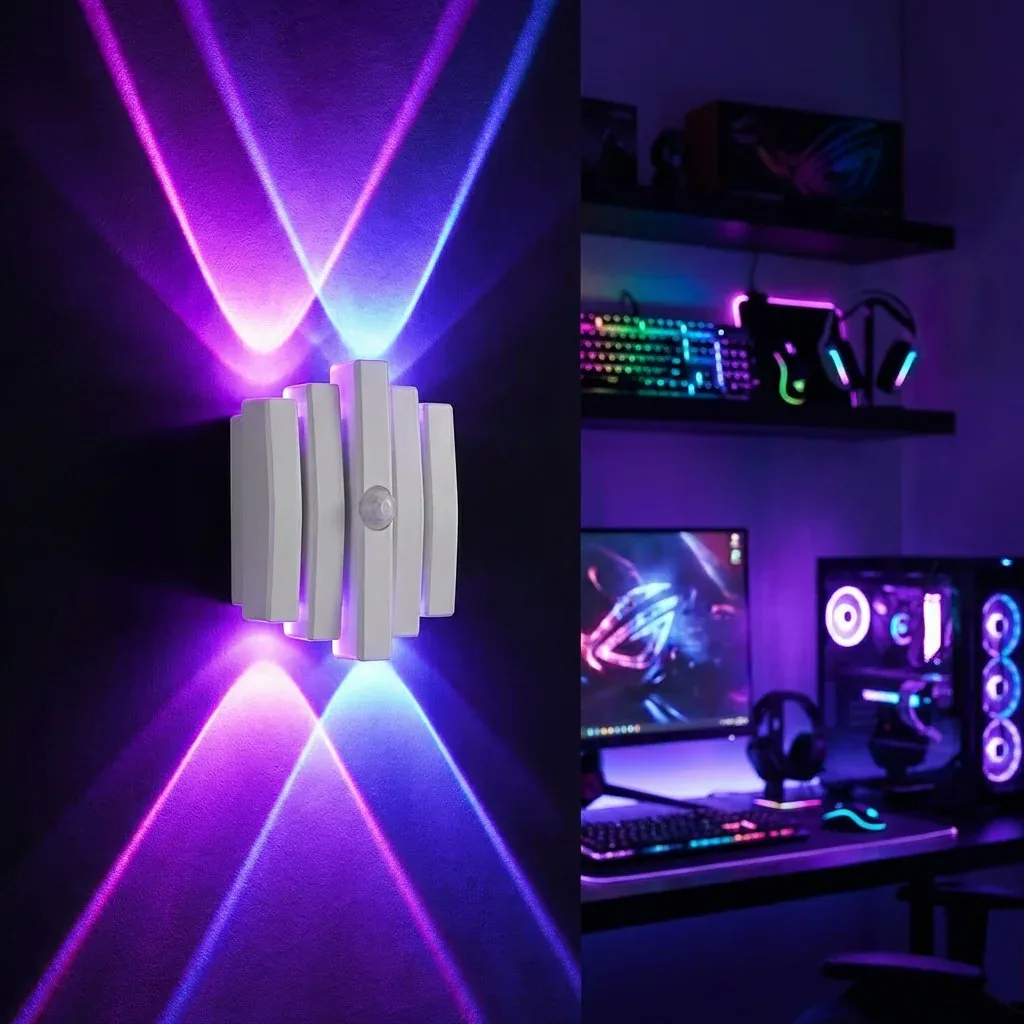
First: Is It a Sconce or a Night Light?
The distinction matters because it changes where the light goes.
- A night light is a single small source, usually aimed at the floor or the wall, meant to stop you tripping.
- A sconce is a wall-mounted fixture that shapes light — often upward, often in two directions, usually at a height where it reads as part of the room rather than an accessory.
If you want the room to look designed rather than just lit, you want the second one. A dual-head fixture with separate up and down beams does that; a small night light on a wall does not.
Route 1: Adhesive Mounting Plate
Most renter-friendly wall lights ship with a thin plate that sticks to the wall and holds the light magnetically or by a keyhole slot. This is the most flexible route because the light itself can be lifted off for charging while the plate stays put.
Works on: smooth painted drywall, painted wood, laminate, tile, glass.
Fails on: textured cinder block, brick, rough plaster, wallpaper, and paint that has cured for less than about a month. On those surfaces the adhesive contacts only the high points of the texture and holds a fraction of its rated load.
Removal: warm the plate with a hair dryer on low for 20-30 seconds, then peel slowly and parallel to the wall rather than pulling outward. Pulling outward is what lifts paint.
Route 2: Magnetic Mount
If the wall has no good surface, stop fighting it. A magnetic base attaches to anything steel: a metal bed frame, a filing cabinet, a locker, a metal shelf bracket, the side of a mini fridge, a steel stud behind a painted panel.
This is the route with the least risk, because nothing is stuck to a landlord's paint. In a rental, the strongest play is often to mount the light on furniture rather than on the wall — a floor lamp frame, a metal headboard, a bookshelf upright — and let it graze the wall from there.
Fails on: aluminium frames, most IKEA particleboard furniture with no steel inserts, and painted wood where the magnet has nothing to grab.
Route 3: Plug-In Sconce With a Cord
The traditional renter answer: a sconce with a cord and an inline switch, plugged into a wall outlet. It is genuinely bright and genuinely permanent-feeling, but it brings two problems.
- Cord management. An unsightly cord down the wall is the reason most people give up on this route. Cord covers help, but they still need adhesive and they still look like a cord cover.
- Outlet dependency. You need an outlet where you want the sconce, which is rarely where you want the sconce.
If you have an outlet in the right place, this route gives the most light for the money. If you do not, it is the wrong tool.
Height and Spacing Rules That Actually Matter
Sconce placement is one of the few lighting decisions with a defensible right answer:
- Bedside sconce: mount at roughly 48-56 inches (122-142 cm) from the floor, so the shade sits just above a seated shoulder and the light falls on your book, not in your eyes.
- Hallway or stair sconce: 60-66 inches (152-168 cm) is the usual rule — high enough to clear heads, low enough to light the wall rather than the ceiling.
- A pair: space them symmetrically about the feature they flank, and keep the gap between them at least as wide as the gap to the nearest corner, so they read as a pair rather than as one stray fixture.
- Above a picture or headboard: the light should sit close enough that the pool of light lands on the object, usually 8-14 inches above it.
The most common mistake is mounting a sconce at eye height while standing. It looks correct on a plan and glares straight into your face when you sit down.
Where Not to Mount It
- Inside a shower or bath zone. Standard ZSYZDL lights are IP20 indoor-rated, which means dry locations only. Steam and spray are out of scope.
- Directly above a heater, radiator or stove. Heat plus a battery is a bad combination.
- On wallpaper or fresh paint. The adhesive will take the finish with it.
- Where the beam hits a mirror at head height. You will be looking at the source in the reflection every time you walk past.
Removing It Without Losing the Deposit
- Photograph the wall before mounting, so you have a baseline at move-out.
- Warm the adhesive before removal. This is the single step people skip.
- Peel parallel, slowly, supporting the wall with your other hand.
- Clean residue with isopropyl alcohol on a cloth, not with a solvent or an abrasive pad.
- If a patch of paint lifts, report it. A reported small patch is usually normal wear; a hidden one is a charge.
Choose the route by your wall, not by the product photo. Smooth painted drywall gives you all three options; cinder block gives you magnets on furniture; wallpaper gives you magnets only.
Sconce Light, No Junction Box
Dual-head up-and-down wall lights with a magnetic no-drill mount and USB-C charging. See current prices on Amazon US.