Somewhere around the second birthday, a child who happily slept in the dark starts asking for the door open, then for the hall light, then for a light in the room. This is not a regression and it is not manipulation. It is the point where imagination arrives before the ability to reason about it, and the dark becomes a place where things could be.
A night light helps. But the wrong one makes sleep worse, and the wrong placement turns a sleep aid into a toy. Here is the version that works, and the four ways it usually goes wrong.
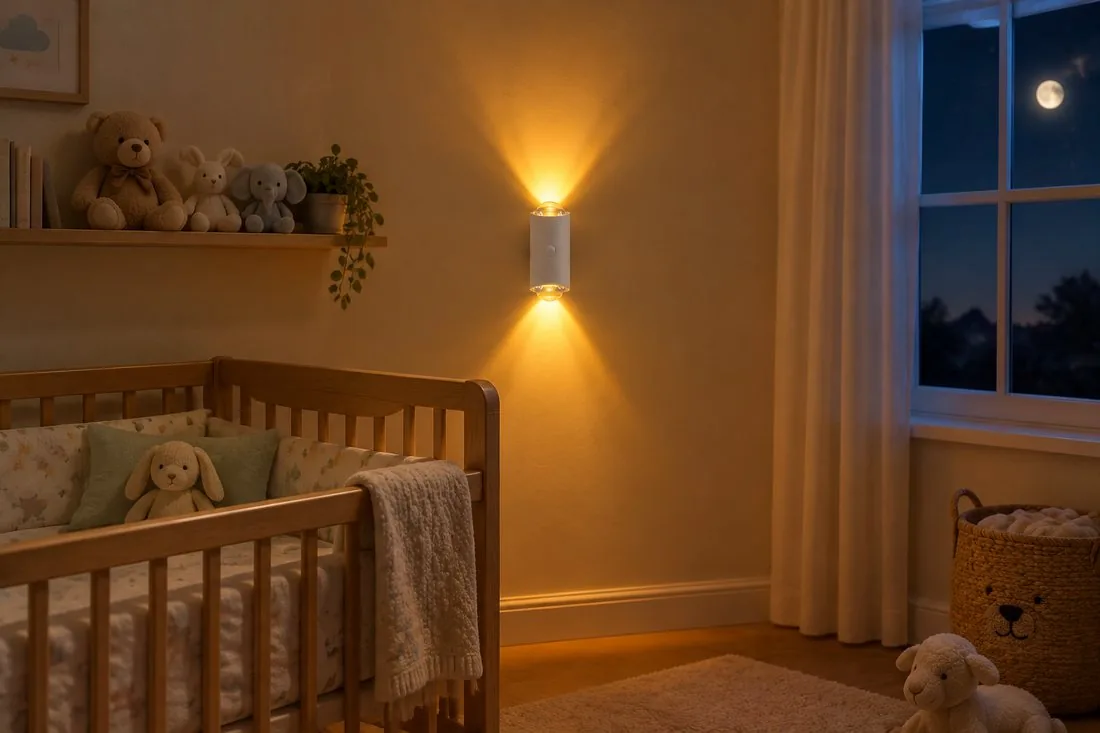
What the Fear Actually Is
Between roughly two and four, children develop the ability to picture things that are not there — which is the same skill that produces imaginary friends and monsters. At the same time they are working out that they are separate from you, which makes being alone feel bigger than it did.
The practical consequence: reassurance matters more than illumination. A brighter room does not resolve the fear; a predictable routine plus a reliable, boring, dim light does, because it turns "the dark is unknown" into "the dark is the same as it was last night".
Colour: Warm, Not Blue-White
Light colour affects how alert we feel. Blue-rich white light — the kind that comes from a cool white LED — is more alerting than warm light, and research on light and sleep generally points the same way: warmer, dimmer light is the friendlier choice close to bedtime.
So the shortlist is:
- Deep amber or red-orange — the least disruptive option, and enough to see the edge of the bed and the door.
- Warm white — fine if it is genuinely dim. Most warm white night lights are dimmer than they look in a dark room.
- Avoid cool white and bright blue. It reads as daytime, and it makes the room feel like a screen.
Brightness: You Want Outlines, Not Detail
Test it properly: stand in the room at bedtime with the light on and the door closed. You should be able to see the shape of the furniture and the path to the door. You should not be able to read comfortably.
If you can read, it is too bright for sleep and it will start pulling bedtime later. If you cannot see the door, it is too dim to do the job it was bought for.
Placement: Low, Out of the Sightline, Away From the Bed
Four placement rules, in order of importance:
- Below mattress height. Light at or above mattress level shines into the child's eyes when they sit up, which is alerting rather than settling.
- Out of the direct line of sight from the pillow. If they can look straight at the source while lying down, they will.
- At least a metre from the bed. Close enough to reassure, far enough that it is not a toy within reach.
- Lighting the path, not the room. Between the bed and the door is the most useful place a light can be, because that is where the fear is.
If the room has no reachable socket at that spot, a rechargeable light mounted low on the wall solves it without a cord trailing across a floor at night — which is the one thing you should never accept in a toddler's room.
Motion Sensor or Always On?
For a toddler, always on and dim beats motion-triggered in most cases. A motion light that switches on when they move can startle a half-asleep child, and it teaches them that getting out of bed produces a reward (light), which is the opposite of what you want at 2am.
Motion sensing is the better choice for the hallway outside the room, where the goal is navigation rather than comfort. Our hallway and stair lighting guide covers that pairing.
Safety Rules That Are Not Optional
- No cords within reach of the cot or bed. This is the one rule that has no exceptions.
- No button batteries. Anything small enough to swallow should not be in a toddler's room.
- Low heat only. A light that is warm to the touch after an hour is fine; one that is hot is not.
- Out of arm's reach from the mattress — mount it, do not stand it on a shelf the child can reach at 3am.
The Three-Week Fade-Out
The goal is a light that becomes less necessary, not one that becomes a permanent requirement. A gradual approach usually works better than removing it abruptly:
- Week 1: the light is on at bedtime, at the chosen low brightness, in the chosen spot. No changes. Predictability is doing the work.
- Week 2: same position, one step dimmer. If the child notices and objects, hold for a few more nights.
- Week 3: move it further toward the door, or switch to a mode where it turns off after a set time.
Many families never get past week 2, and that is fine. A dim light that helps a four-year-old sleep is not a problem to be eliminated.
The Four Ways It Backfires
- Too bright. The most common mistake, because a light that looks gentle in daylight looks like a spotlight at 9pm.
- Wrong colour. Cool white at bedtime is a small daily dose of "it is daytime".
- It becomes a toy. A light with buttons, colours and modes invites play at exactly the wrong time. Look for one with a single setting, or one you can lock.
- The position keeps changing. Novelty is the enemy of a sleep association. Pick a spot and leave it there.
None of this is complicated, and none of it requires a specialist. Pick warm and dim, mount it low and away, keep it boring, and let repetition do the work.
A Calm Light for Bedtime
Warm, low-brightness night lights with motion sensing and USB-C charging — no cords near the bed.